
Protect yourself and your family

Dear Intimcity Community,
For us, it’s all about enjoyable, fulfilling encounters. To keep it that way, responsible education is essential. Syphilis is back—and it’s more widespread than many people realize.
In Vienna alone, 485 new cases of syphilis were reported to the city’s health department in 2024 (and 1,710 cases when gonorrhea is included—nearly two-thirds more than a decade ago). There is no mandatory reporting system in place nationwide in Austria, so exact national figures are unavailable. However, the trend is clearly on the rise, just as it is across Europe.
Complete figures for 2025 are not yet available, but the upward trend in Europe continues: In 2023, over 41,000 confirmed cases were reported in the EU/EEA—a 13% increase from 2022 and twice as many as in 2014. We are also seeing this upward trend in Austria.
That’s why we’ve put together all the important information here—concise and honest—so you can stay safe and relaxed.
What exactly is syphilis?
Syphilis (also known as lues) is a bacterial infection caused by Treponema pallidum. It is transmitted almost exclusively through sexual contact—vaginal, anal, or oral. Even contact with small, often invisible sores or mucous membranes is enough to transmit the infection. Condoms provide good protection, but they are not 100% effective.
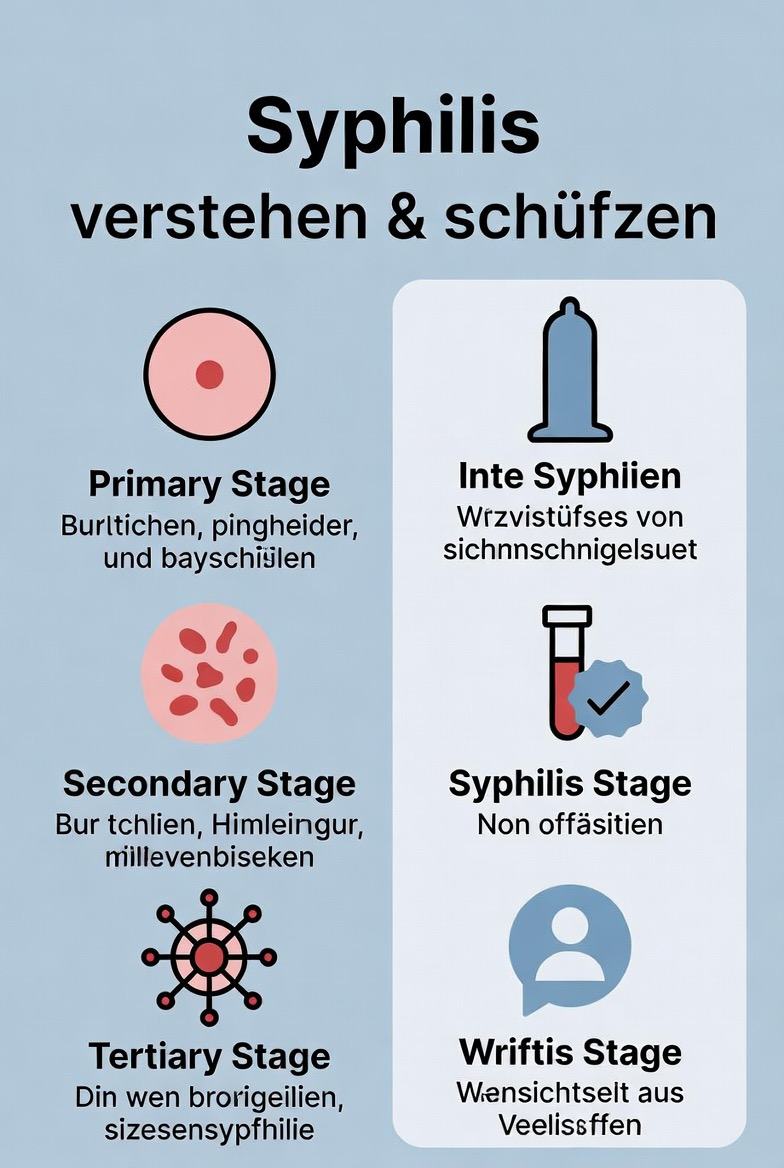
The Stages of Syphilis – How It Progresses
The disease progresses in several stages. Many symptoms go away on their own—but the infection persists.
- Primary stage (approx. 2–12 weeks after infection)
A painless, hard sore (“chancre”) on the penis, vagina, anus, or in the mouth. It often heals on its own after 3–6 weeks. Many people do not even notice it. - Secondary stage (weeks to months later)
Rash (including on the palms of the hands and soles of the feet), fever, fatigue, swollen lymph nodes, hair loss, or sores in the mouth. Highly contagious! - Latent stage
No more symptoms—but the bacteria are still in the body. - Tertiary stage (after several years, if left untreated)
: Severe damage to the heart, brain, blood vessels, bones, or eyes. If left untreated, syphilis at this stage can, in rare cases, be fatal (historically in 8–17% of untreated cases). Today, this is extremely rare because most cases are treated in time—but it is preventable.
Important in cases of multiple infections: Having had and been treated for syphilis does not protect against new infections. You can become infected multiple times. Each new infection progresses independently. Multiple infections increase the risk that at least one infection will be detected too late and progress to the tertiary stage. Recent studies also show an increased risk of cardiovascular diseases (e.g., heart attack, stroke) in late-stage syphilis.
Important: Syphilis is particularly dangerous during pregnancy (risk to the baby). In people who are HIV-positive or who have had repeated infections, the disease can progress more rapidly and be more severe.
How is syphilis diagnosed and treated?
A simple blood test will provide clarity (anonymous testing is also available). The sooner, the better. Treatment is straightforward: usually one or a few penicillin injections. The bacteria are sensitive to the medication, and resistance is virtually unknown. After treatment, you will be cured and no longer contagious.
Partners should also be tested and treated if necessary.
How can you protect yourself effectively?
- Regular STI testing (every 3–6 months if you have multiple sexual partners)
- Use a condom every time you have sex (including oral sex)
- Open conversations: “When was the last time you got tested?”
- No sex if you have open wounds or unclear symptoms
- PrEP protects only against HIV—not against syphilis!
Where can you get tested in Austria?
- AIDS-Hilfe Wien → Anonymous testing for syphilis and other STIs (Syphilis test: €15)
- Venermed or other sexual health clinics in Vienna
- Your family doctor or dermatologist
- Many pharmacies and laboratories offer discreet options
Just search for “anonymous STI testing [your city]”—there are plenty of low-barrier options available.
Further official information: Ministry of Social Affairs – Sexually Transmitted Infections
Conclusion: Responsibility in Practice
The best protection is always safe sex with a condom and regular testing. If you still want to have unprotected sex, you should at least choose officially registered sex workers. In Austria, registered sex workers are legally required to undergo regular health screenings (every 6 weeks for certain STIs, every 3 months for HIV and syphilis). They receive an official health certificate (“green card” / cover).
Private, unregistered service providers are not subject to this requirement and often visit the doctor less frequently. This makes registered escort profiles on platforms like Intimcity significantly safer—provided you are open about recent test results and prioritize mutual responsibility.
Multiple infections are a clear warning sign of increased risk. The more often you get infected, the greater the chance that an infection will go unnoticed. Syphilis is curable—but only if it is detected early.
Syphilis isn’t a “fate” and it’s nothing to be ashamed of. Anyone who is sexually active—whether in private, as an escort, or with multiple partners—should get tested regularly. This protects you, your partners, and the entire community.
At Intimcity, we don’t just want to facilitate steamy encounters—we also want to be a responsible and safe community. Stay healthy, stay curious, and look out for one another!
Questions? Feel free to leave a comment below or send us a message. And please share this post—raising awareness helps everyone.
Sources: City of Vienna Health Department (2025), ECDC Syphilis Report 2023, Ministry of Social Affairs, AIDS-Hilfe, current studies on cardiovascular risks associated with syphilis. As of April 2026.

Autor
Hannes Obermoser